Objects with a reputation
Why does a common perennial legume or an iron horse harness travel from pastoral labor into international lore as an instrument of divine protection?
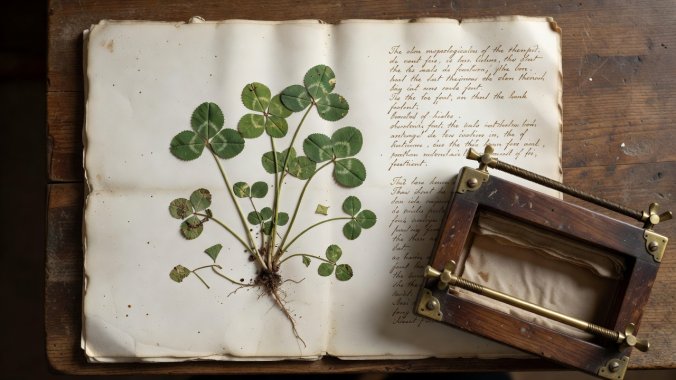
The botanical genesis of the quadrupled foliole
White clover (Trifolium repens) blankets the agricultural grasslands of Eurasia. Under ordinary phenotypic expression, clover develops three distinct obovate leaves—a tripartite geometry that Christian evangelists across the British Isles and the Scandinavian rim readily linked to the Holy Trinity. When an aberrant hormonal trigger or recessive allele creates a fourth foliole, the rarity is stark: botanical surveys indicate roughly 1 occurrence per 10,000 specimens.
Because finding one required prolonged, deliberate inspection of pastures during harvesting or herding, early modern Nordic farmers considered the discovery an omen of extraordinary vision. By the 16th century, regional manuscripts such as John Melton’s Astrologaster (1620) recorded the belief that anyone finding a four-leaf clover would soon encounter good luck or discern witches and malevolent spirits disguised as neighbors.
"The value of the talisman is rarely rooted in its chemical composition; it is forged by the labor of its finding and the cultural scaffolding erected around its scarcity."
Forged iron and threshold mechanics
Horseshoes hold an equally venerable position across northern Europe, the Levant, and North America. In early agrarian societies, the blacksmith (or ferrier) held high cultural esteem, manipulating fire, water, and ore to tame wild minerals. Cold iron was universally credited in European lore with repelling subterranean spirits, fairies, and malevolent curses that disliked human metallurgy.
The orientation of the shoe above doorways generated profound regional disputes that survive today:
| Object / Tradition | Geographic Epicenter | Mechanic of Belief | Observed Material Function |
|---|---|---|---|
| Four-Leaf Clover | Ireland, Scandinavia, British Isles | Scarcity (1 in 10,000) assigned divine favor; early herbarium keepings. | Agricultural marker of legume health; visual search training. |
| Upturned Horseshoe | British Isles, Anglo-America | Resembles a chalice; collects good fortune before it spills over the lintel. | Durable iron fixture sealing barn wood against settling gaps. |
| Downturned Horseshoe | Nordic coasts, Germany | Showers protective fortune downward onto anyone walking under the portal. | Direct physical shield over threshold masonry joints. |
| Dried Oak Acorn | England, Scandinavia | Sympathetic longevity; protects roof structures from lightning strikes. | Pest-resistant tannins preserving timber accents in damp climates. |
Materiality and the human need for tactile anchors
What unites these objects is not supernatural efficacy, but cognitive palpability. In moments of illness, maritime voyage, or agricultural famine, humans crave tangible objects they can finger in their waistcoat pocket or nail above their threshold. An object gives abstract hope a physical weight, enabling our nervous system to transition from vigilance into regulated calm.
Continue the investigation: